List of changes to this page (most recent 2026 August 1)
On 2026 August 5, within a few minutes of 06:35 UTC, an upper stage (section) of a rocket used for a lunar mission will hit the moon. This may be of some (probably minor) scientific interest, and we may learn some things from it. It doesn't present any danger to anyone, though it does highlight a certain carelessness about how leftover space hardware (space junk) is disposed of.
This is the second time I've identified a piece of junk as being about to hit the moon. That event got considerably more attention than I'd expected, including from non-astronomers. I'm hoping the following will answer most of the questions people are apt to have about this new event.
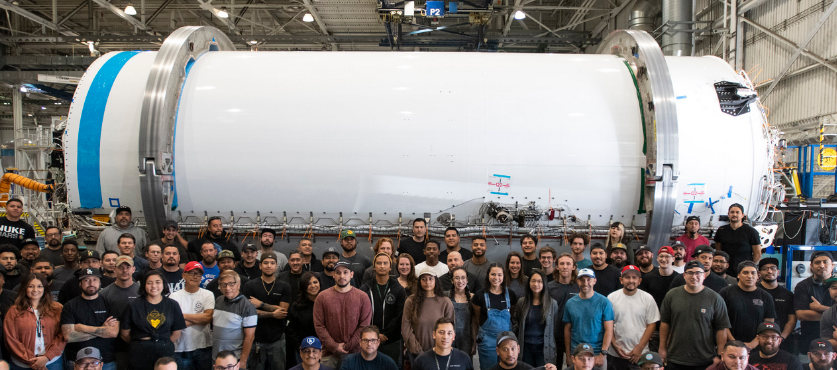
This is the upper stage of a Falcon 9 rocket. The Falcon 9 is SpaceX's workhorse rocket. These rockets have two stages. The first, larger stage gets the payload (and upper stage) most of the way to orbit, and then comes back to earth and lands on a barge, and can be re-used. The upper, smaller stage goes into orbit and can't be re-used. As you can see in the above image, it's still quite a large object, roughly the height of a five-story building.
Over 600 Falcon 9 rockets have been launched. Most of the upper stages are either in orbits close to the earth or have already re-entered the earth's atmosphere. A few are orbiting the sun. The object that will be hitting the moon has been orbiting the earth for a little over a year.
The object doesn't have a name, just an official catalog designation of 2025-010D. That tells you that it was on the tenth rocket launched into orbit in 2025, on January 15 of that year, and was the fourth bit of hardware to be tracked from that launch. The purpose of the mission was to launch the Blue Ghost and Hakuto-R landers to the moon. Those were designated 2025-010A and 2025-010B. They were held together by 2025-010C, a "payload canister".
2025-010D was the Falcon 9 upper stage, a rocket that propelled everything else from a low orbit around the earth into an orbit that could reach the moon. Once it had done that, all four objects separated from each other.
Over the following weeks and months, all four pieces were tracked by the telescopes of asteroid surveys and amateur astronomers. Blue Ghost landed on the moon on 2025 March 2. Hakuto-R took a much more circuitous route to save on fuel, and attempted to land on 2025 June 5. Unfortunately, contact with it was lost about 90 seconds before landing, and it crashed.
The payload canister, 2025-010C, kept orbiting the earth and re-entered the earth's atmosphere at 12:06 UTC on 2025 March 15, near the border between Argentina and Chile. I don't know if anybody actually saw it. If they did, it would have looked like a fairly bright meteor.
The upper stage, 2025-010D, also kept orbiting the earth, but was a bit higher and didn't re-enter. It's had a few close passes by the moon and earth, but nothing that was close enough to look like a possible impact. The asteroid surveys observed it whenever it wasn't too close to the sun or moon to see. As of 2026 February 26, we had accumulated 1053 observations of it.
This object has spent almost all of its time at distances similar to that of the moon. Generally speaking, such objects are very poorly tracked. The US military mostly tracks objects using radar. That does a superb job of tracking low-orbiting junk; they've tracked gloves and tool bags that astronauts have lost over the years. But the moon, and objects like 2025-010D, are about 400 times further away; the radar signals are about 25.6 billion times fainter. (If an object is 400 times further away, it receives 1/400 squared, or 1/160000, as much radar energy. And of that, only 1/160000 as much is returned to earth.) Basically, the radar works well for "close" stuff, and the telescopes work better for more distant objects.
However, these objects are entirely observable by the asteroid surveys, and even by amateur astronomers with suitably advanced gear and techniques. You can click here to see observational data gathered by amateur observers and the resulting orbit and impact prediction. (This is in a somewhat opaque form that is quite familiar to asteroid observers.) This includes observations from five observatories in Mississippi, Utah, Beijing, and England.
As we approach the impact, it's become particularly important to have some data to reduce the uncertainties in the impact time and location. That caused me to make a request on the Minor Planet Mailing List for more observations. That's worked well; I've received additional data that have helped refine the impact prediction. (It also helps that I have data from multiple sources that all fit together well. If anybody were getting bad data, I'd be able to tell.)
The asteroid surveys have gotten even more data on this object. They would actually prefer not to observe space junk. Their job is to find and track rocks that might hit the earth ("planetary defense" in the US, or "planetary defence" if you're in Europe.)
From the viewpoint of the asteroid observers, time spent observing junk is time not spent finding rocks. But both the rocks and the high-altitude space junk are slowly moving points of light in their images; they aren't easy to distinguish. So the asteroid surveys find this sort of junk whether they want to or not.
For some time, I've provided some software tools astronomers can use to identify satellites in their data. I use the US military's publicly available satellite data for many objects, and compute orbits for high-orbiting objects the military doesn't track.
This object falls squarely in the latter category. In September 2025, my software for computing orbits analyzed the observations and projected an impact with the moon on 2026 August 5.
While this looked like a pretty solid prediction, I couldn't be totally sure of it at the time. The motion of space junk is mostly quite predictable; it simply moves under the influence of the gravity of the earth, moon, sun, and planets. We know those with immense precision. If those were the only factors involved, I could probably tell you where and when this object would hit the moon to within a few meters and a fraction of a second.
The problem is that space junk in general, and 2025-010D in particular, is also pushed around by sunlight ("solar radiation pressure"). This is an extremely gentle force, but over months, it can really build up. And it's not entirely predictable. As an object tumbles, it may catch more or less sunlight, and may reflect some of it sideways. So sunlight is mostly pushing the object away from the sun, but there's a slight bit of pushing in other directions as well.
With enough data, we can actually figure out where the forces are pushing an object. But they do change a little over time in ways that aren't perfectly predictable. So I can be sure it will impact near the time and place I've predicted, but those varying forces mean that the actual impact will be at least a little off from that time and place. That's the largest source of uncertainty in all this, and there's no way to correct for it; we just have to wait and see what actually happens. (But come August, we'll have a quite precise idea of where it will hit.)
With the data I've seen as of 2026 August 1, I'm computing an impact on 2026 August 5 at 06:35:37.5 UTC (Universal Time), probably plus or minus a few seconds. Locally, that will be :
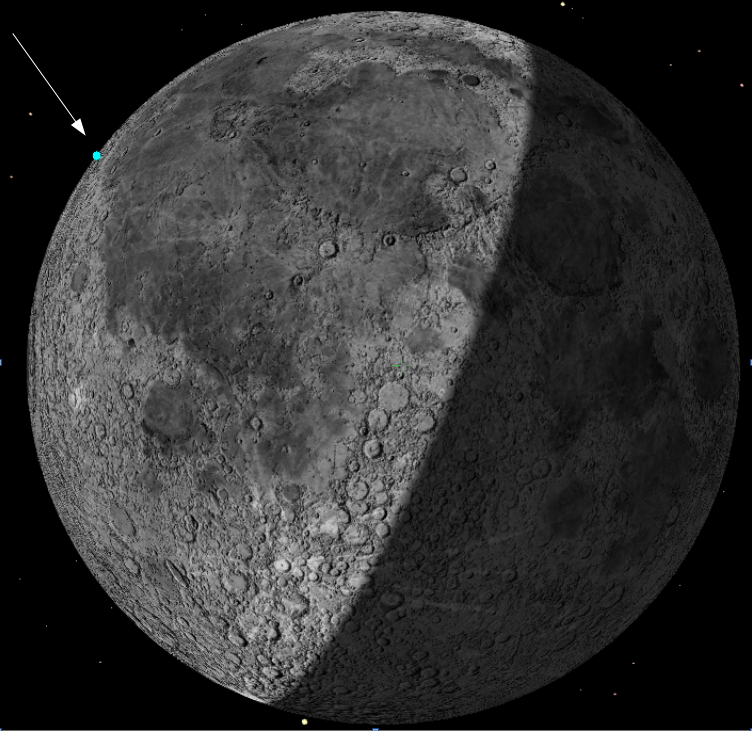
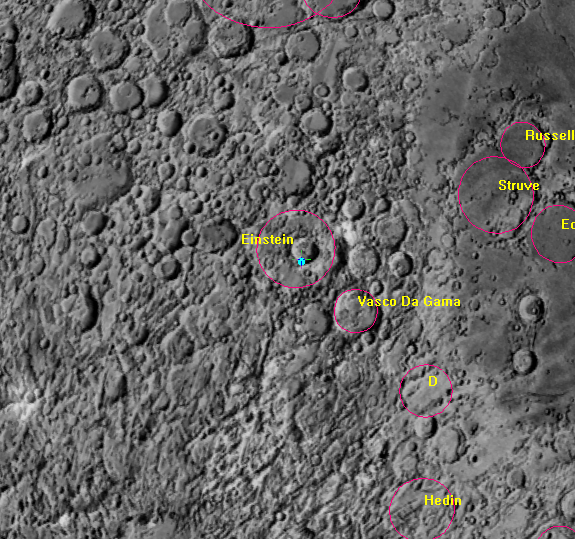
The impact point will be at lunar latitude 19.461 N, longitude 266.707 E = 93.293 W. The first image shows how it'll look from the earth, with the impact at the blue circle-and-cross symbol. Somewhere close to that place and time, anyway; as described above, some parts of the motion of this object aren't entirely predictable. It will be close to the edge ("limb") of the moon as seen from earth, on the sunlit part. The moon will be a little more than half illuminated at the time.
The second image is a closer look from directly above the impact point. The impact will be close to the crater Einstein, in a heavily cratered part of the lunar surface.
In theory, the time is good to about half a second, and the position to about 0.01 degrees (which is about a third of a kilometer or around 300 yards). The problem is that the theory doesn't account very well for those unpredictable bits; I'm not really trusting the above to better than a few seconds and a few kilometers.
Note, though, that you should not look for the impact, wait ten seconds after the predicted time, and then turn away from your telescope. You may be able to see the ejecta plume, and it may take some time -- perhaps minutes -- for it to rise up and become visible.
However, we will have a more exact impact time and location a bit before it hits. In the days before impact, it will be quite well placed for telescopic observations (it won't be in daylight, or too far away, or poorly illuminated by the sun). About the worst issue we'll start to encounter, as the object is a day or so from impact, is that it becomes hard to see a faint piece of junk when the moon is shining close by.
The reason we'd like as precise an impact point as possible is to help in figuring out where to find and image the resulting crater. I expect we'll be able to tell the LRO folks exactly where to look in their images for the crater.
Because we know it's a Falcon 9 upper stage, we have a good idea of its dimensions, and know that has a mass of about 4900 kg. (The mass was, and remains, something of an unknown for the Chang'e-5 T1 upper stage that hit the moon. We were a little surprised to see that it made a double crater; the current guess is that there was a heavy motor at one end plus a heavy payload near the top of the upper stage. But we don't really know, and the China National Space Agency isn't saying... in fact, as far as I know, China has yett to say that it was their bit of junk.)
Several observers have noticed changes in brightness as the object spins. Grant Privett, an observer in the UK, took a 12-minute exposure in which you can see the object brighten and fade five times. And Jean-François Gout got this light curve, showing the rise and fall in brightness over a period of a little over three minutes.
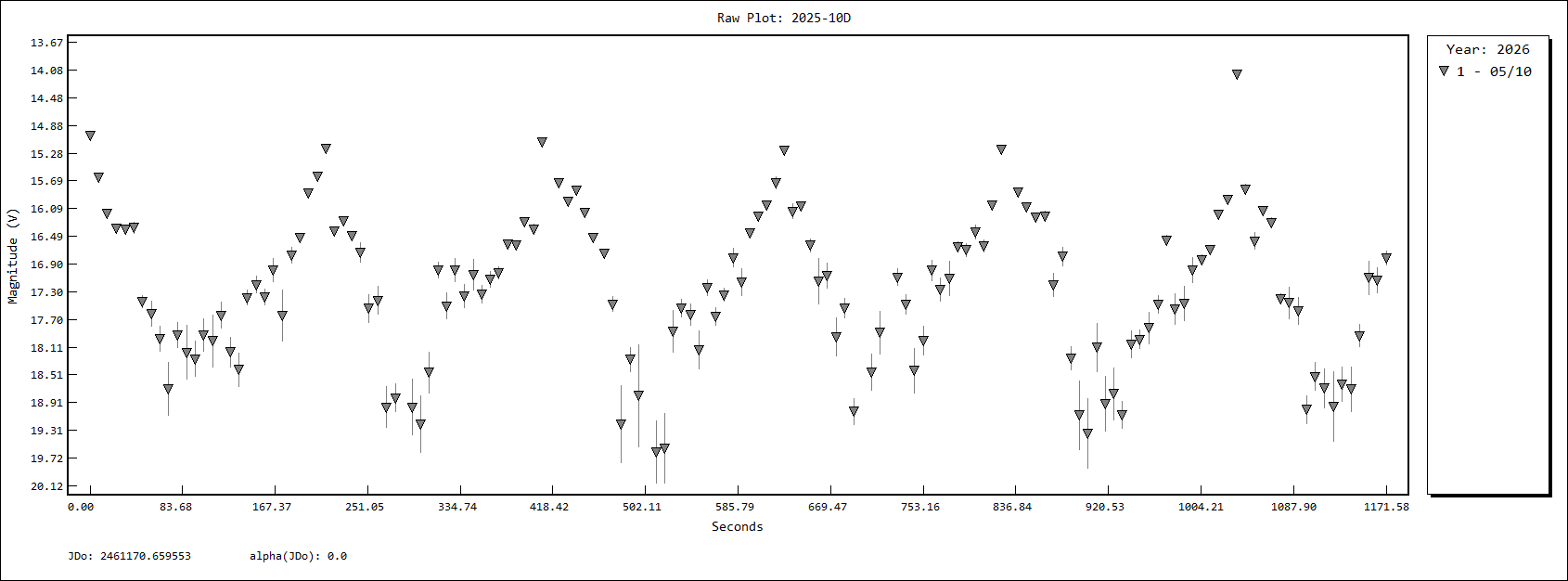
Further observations of this type may help us to figure out more specifically how it's tumbling. That, in turn, may help us figure out how solar radiation pressure is affecting the object, and refine estimates of exactly where it will impact.
The Chang'e-5 T1 upper stage was well-observed, and we were able to get some information showing that the light reflected from the paint matched similar Chinese upper stages. It is likely that similar studies will be made of this object.
2.43 kilometers a second, or 1.51 miles a second, or 5400 miles an hour, or 8700 kilometers an hour.
There is, of course, no air and no sound on the moon, so a "Mach number" doesn't really make sense. But if there were air, the speed would be about Mach 7, seven times the speed of sound.
The impact probably won't be. The ejecta plume might be. Surprises are possible; it will probably be at least worth taking a look.
This bit of the puzzle is actually a little outside my realm of knowledge. I know quite a bit about figuring out where things in space are going to go, but impact physics is its own specialty. I can easily compute, with quite good accuracy, how much energy the object would release on impact, but what fraction would come out as light? Would most of that energy go into scooping out a big crater and scattering debris across the moon?
I did have hopes that it would be quite visible. The impact will occur about a week after Full Moon. For people in the eastern half of the US and Canada, and in much of South America, the moon will be above the horizon and it'll be night. People in those parts of the world will at least have no problem at all in seeing the moon.
The last time a similar object hit the moon, it did so on the far side, and we didn't get to see it happen. (Though three months later, the crater caused by that impact was imaged by a spacecraft orbiting the moon.)
For 2025-010D, the impact point is currently expected to be (just barely) on the near side of the moon (the one we can see from earth). It's possible that by August, further data will show that the actual impact point is shifted a little toward the far side (the one only spacecraft and astronauts get to see). I don't expect it to shift by that much, but space junk can do some odd things over a few months, and I can't completely rule it out yet. (By the time August 5 comes around, we will have a very exact idea of where and when the impact will occur, probably to within a few dozen meters and a fraction of a second. We will be collecting data almost right up to the time of impact.)
After talking to a few people, I was less confident we could see it, even if it's not on the far side of the moon. The biggest reason is that we've had a similar situation before. In 2010, a rocket stage was deliberately sent to impact the moon. The idea was to see if it kicked up ice under the lunar surface (inconclusive results). The impact was carefully timed to occur on the unlit part of the moon, at a time when it could be observed by large telescopes. They didn't see anything.
However, some people are going to try. The fact that the impact is really close to the limb may actually turn out to be an advantage. Rocks ejected by the impact may form a "plume" that will be visible against the dark background once they're off the moon. As with much in science, the answer is "we don't know; let's find out". Maybe we'll see the flash. Maybe we'll see rocks ejected from the crater. Maybe we'll even see both.
Incidentally, the energy is simply that of 4900 kilograms hitting the moon at 2430 meters a second. Apply the good 'ol E=½mv² formula, and you get 14.5 billion joules, or roughly the energy in 15000 sticks of dynamite, or the energy about three tons of TNT.
However, there's another problem, recently pointed out by Bill Cooke, of NASA's Meteoroid Environment Office. We do see flashes from meteor impacts on the moon. But your average rock is moving considerably faster than a mere 2.43 km/s; speeds of the order of 10 km/s are common, going up to a maximum of about 70 km/s.
The greater the speed, the more energy is released as visible light (instead of as heat or just moving lunar material around). 2025-010D will release a lot of energy when it hits the moon. But only a small fraction is likely to come out as light.
As noted above, things look grim (though not impossible) for seeing a flash when 2025-010D hits the moon. However, the impact currently looks to be occurring almost exactly on the lunar limb, in sunlight. Lunar material blasted out by the impact might, conceivably, rise high enough from the surface to become visible as it separates from the limb.
Nobody seems to have a very good guess as to how likely this is. However, we can do the following approximate calculation. (Bottom line : visibility of the ejecta again looks unlikely, but not impossible. As with the flash, taking a look would be worthwhile. Note that it may take a minute or so before the ejecta rises high enough to be visible, so it'll be worth looking for a bit after the actual impact.)
The roughly comparable impact of the Chang'e-5T1 upper stage made two craters on the moon, of roughly 18 meter and 16 meter diameters. The current thinking is that one of the crater was due to a rocket motor (where most of the mass usually is in an upper stage), and that the other was due to an unknown payload on the top of the upper stage.
2025-010D lacks such an extra payload. (It was carrying two spacecraft to the moon; I've been told this was right at the limit of what it could do.) So it will presumably make a single crater of roughly 17 meter diameter.
I don't really know how deep the crater is, but will guesstimate an average depth of about two meters. So the Chang'e-5T1 upper stage "excavated" material roughly equivalent to a cylinder 17 meters across and two meters deep. That's about 450 cubic meters of lunar material. If it has a density of about 2.5 gm/cm³, that's about 1100 tonnes, blasted out and scattered over the rest of the moon.
A couple of paragraphs above, I computed the amount of energy released by 2025-010D on impact to be about 14.5 billion joules. That's about 14000 joules per kilogram of ejecta, or enough to propel it at about 160 meters a second. (Less than that, since we can be sure that we won't get 100% of the energy put into moving the ejecta. We do know that -- as described above -- the slow speed of impact means that the energy won't be going into a visible flash, though.)
Let's say that rocks are blasted out at 100 meters a second. On the moon, if you are a rock shooting upward at that speed, you will rise for about one minute, reaching a height of three kilometers. You'll then plummet down for a minute and be returned to the moon.
This close to the lunar limb, ejecta at an altitude of three kilometers would be visible, just barely, away from the lunar limb. We do have the problem that, at this distance, the separation is a mere 1.5 arcseconds. Which is why, as stated above, I'm not very optimistic about seeing the ejecta plume.
However, you will notice the tower of assumptions and guesses in the above. Maybe some ejecta gets kicked higher than others. If you do imaging for ejecta, I'd recommend looking before impact and for at least a few minutes afterward. Your best hope is that some bits are ejected at, say, 300 m/s, and therefore rise for three minutes instead of one, and reach a height nine times greater than the above guesstimate.
There's both a general and a specific answer to that.
The general answer is that it's in an orbit around the earth, taking about 26 days to go around us. The orbit is lopsided; at its closest (perigee), the object is about 220000 kilometers (137000 miles) from us. At its farthest, it gets out to 510000 km (310000 miles). For comparison, the moon is about 385000 km (240000 miles) away.
The orbit of the moon and of this object, roughly speaking, intersect. Usually, one goes through the intersection point while the other is someplace else. But on August 5, they'll reach that point at the same time.
If you want a more specific answer -- where is it in the sky at a given time, and where should I point a telescope if I want to see it -- you can use this artificial satellite ephemeris service. You tick the check-box for 2025-010D, enter a time span for which you want data, tell it where on the earth you're observing from (your latitude/longitude), and it'll figure out the coordinates in the sky and distance at that time.
Alternatively, you can now go to JPL's Horizons system. Click on the 'Target Body' and enter 2025-010D. Select your ephemeris type, your location, and the desired time span, and then on "Generate Ephemeris".
Warning : these services both assume you know a certain amount about how ephemerides and celestial coordinates work. If you don't, they'll both be nearly meaningless to you.
Almost definitely.
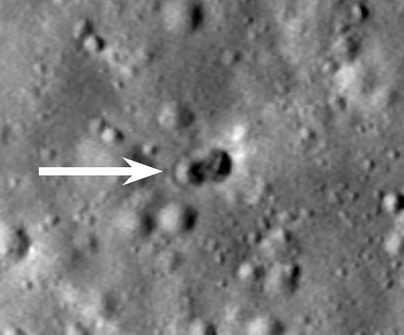 (Courtesy Lunar Reconnaissance orbiter)
This image shows
a pair of craters made in 2022 when the upper stage of China's
Chang'e-5 T1 mission hit the moon. One of the craters is
about 16 meters across and the other about 18 meters across.
The China National Space Administration does not provide figures for the mass
of their rockets, but it probably had a mass similar to 2025-010D, and
we'll probably get a crater of roughly similar size. It will be
coming in at an angle of 31 degrees above the horizon, straight
enough down that I don't expect the crater to be very elongated.
(Courtesy Lunar Reconnaissance orbiter)
This image shows
a pair of craters made in 2022 when the upper stage of China's
Chang'e-5 T1 mission hit the moon. One of the craters is
about 16 meters across and the other about 18 meters across.
The China National Space Administration does not provide figures for the mass
of their rockets, but it probably had a mass similar to 2025-010D, and
we'll probably get a crater of roughly similar size. It will be
coming in at an angle of 31 degrees above the horizon, straight
enough down that I don't expect the crater to be very elongated.
The above image of the double crater was taken a couple of months after impact by the Lunar Reconnaissance Orbiter, a sort of "spy satellite for the moon". The odds are good that LRO will also be able to image the crater caused by 2025-010D.
Well... I wouldn't really worry about it very much. If anything, I'd be more concerned with the many similar objects that don't hit the moon, and hit the earth's upper atmosphere instead.
This is not the first time junk has hit the moon. A similar object hit the far side of the moon in 2022. Back in the early 1970s, the upper stages for Apollos 13 to 17 all hit the moon (quite deliberately; the resulting "moonquakes" were useful for calibrating seismometers that had been left by the preceding Apollo missions.) So did many of the Apollo lunar landers, as well as various probes and associated hardware. In 2009, NASA deliberately crashed an upper stage on the moon to see if it would kick up water ice, to be observed by another spacecraft. And, of course, small asteroids (and some not so small) hit the moon frequently; that's why it has all those craters in the first place.
If this object had hit the earth, as most upper stages do, it would have burned up in the upper atmosphere on re-entering and simply added some fine dust up there. Since this object is instead hitting the moon, there will be a sudden impact, a flash of light, and then some lunar rock blasted out of a crater at high speed, with no air resistance to slow it down. Some of that shrapnel could, conceivably, go flying around and hit one of the Chinese lunar landers. It's very long odds against it; none of them are close to this spot. I don't think it raises the usual risk level of being on the moon noticeably. In spring 2024, a meteor impact made a 225-meter diameter crater on the moon. 2025-010D might make something about a tenth that size. The 2024 impact presumably blasted out about a thousand times more ejecta than 2025-010D will. So the dangers from natural impacts would still dwarf those of artificial ones.
For 2025-010D, the slight risk from ejecta hitting other spacecraft is the only (very minor) reason I can think of to be concerned about its impact with the moon. If we have humans on the moon in the coming years, we might start to worry more about this sort of thing. But it won't be a problem on 2026 August 5.
As discussed above, there's not much to worry about for this specific object. But there are at least three pretty good reasons to see junk in general as a problem already, and they're apt to get significantly worse in the coming years as the sheer amount of junk increases steeply.
• I mentioned a couple of paragraphs ago that this particular object will hit the moon and almost certainly do no damage except to some rocks where it hits, but that if it had hit the earth, it would mostly burn up into fine dust. There are concerns about the particles resulting from re-entering junk polluting the upper atmosphere. I'd argue that it's at least better to have junk hitting the moon than it is to have it hit the earth.
• It's getting to be hard to go out on a clear night without seeing a few satellites at any given time, gliding as "stars" across the sky. If this continues, the experience of going out and looking up at a starry sky is never going to be the same again. Astronomers are concerned about entering an era where every image taken of the night sky is crowded with streaks and flashes from space junk.
• Junk can collide with junk, and with active spacecraft. The International Space Station has had to maneuver a few dozen times to avoid collisions. Obviously, the more junk you have, the more likely such collisions become, and the product of a collision can be still more smaller bits of junk.
The worst-case scenario would be the Kessler effect : we have enough junk in orbit so that a few collisions generate shrapnel that causes more collisions, generating still more shrapnel until just about everything is colliding. The current consensus seems to be that we aren't terribly close to that yet, but it's a reasonable concern as the amount of junk grows.
The simplest is to put upper stages in orbits where they will leave the earth and moon, and end up in orbit around the sun, such that they won't hit us for a long time. The European Space Agency has been thinking about "end-of-life disposal" for spacecraft and junk for a decade or two. For example, when the James Webb Space Telescope was launched in late 2022, its upper stage went into orbit around the sun in a path planned to avoid hitting us for at least the next century, and probably for thousands of years.
I think that interest in this has been spreading. Both SpaceX and the China National Space Administration are very close-mouthed on such matters. But CNSA lunar launches in the past few years have put the upper stages in orbit around the sun, in contrast to their previous pattern of leaving them where they could eventually hit the earth or moon. At least one more recent Falcon 9 upper stage, launched in November 2025 for the EscaPADE spacecraft, was placed so that it will end up orbiting the sun, and I gather from "usually reliable sources" that SpaceX wanted it that way.
Note, though, that this trick only works for a small fraction of junk : missions that were intended to go to the moon or further. The more usual spacecraft going to lower orbits don't have enough energy to escape into orbit around the sun. Avoiding lunar impacts is pretty easy; avoiding the stuff that hits the earth is a much more difficult problem.
(I'll note that I've never been quite sure of whether to say I'm an 'amateur' or a 'professional'. I've made my living as an astronomer for the past few decades, working under contract with various organizations. It's my profession. However, 'professional astronomer', in some circles, implies a PhD. I don't have that.)
I've run the above past several people. Some were knowledgeable about the subject area and pointed out blunders. I also asked a few non-astronomers to read it; they caught places where I lapsed into astronomer-speak and asked various questions that caused me to modify the page.
I expect that once this becomes public, I'll get more such inquiries and will list any resulting changes below. If you see anything wrong or have questions, please contact me.
Except where otherwise noted, anything on this page is in the public domain; feel free to use it. But I'd appreciate it if you sent a link to the address below so I can add a link to the list of articles about this impact.
I can be reached at pôç.ötulpťcéjôřp@otúlm. (If you're a real human, you should be able to enter that address without the accent/diacritical marks. If you're a spammer, my hope is that your software won't puzzle it out.)